




[Product Updates] An Analysis of the Oracle NetSuite SuiteScript 2.1 Migration Path: From Inventory to Migration – Preparing for 2028.2
2026-09-24

Recently, many Oracle NetSuite customers have seen a notification appear at the top of their account home page:
Update Needed: Update Scripts to SuiteScript 2.1 One or more scripts in this account use SuiteScript 1.0, 2.0, or 2.x. Scripts using these versions will stop working in NetSuite 2028.2. To ensure compatibility, convert your scripts to SuiteScript 2.1 as soon as possible.
Let’s make one thing clear: this is a global notification aimed at all Oracle NetSuite customers; it is not an alert specific to any particular account, nor does it indicate that your system is currently experiencing a fault.
As an Oracle NetSuite consulting and implementation partner serving over 400 clients, Hitpoint Cloud has compiled key information and recommendations regarding this upgrade for your reference.
01|Oracle’s Timeline: A Four-Step Rollout, with 2028.1 as a Key Milestone
According to the official Oracle SuiteAnswers article, this migration is scheduled to proceed in four phases:
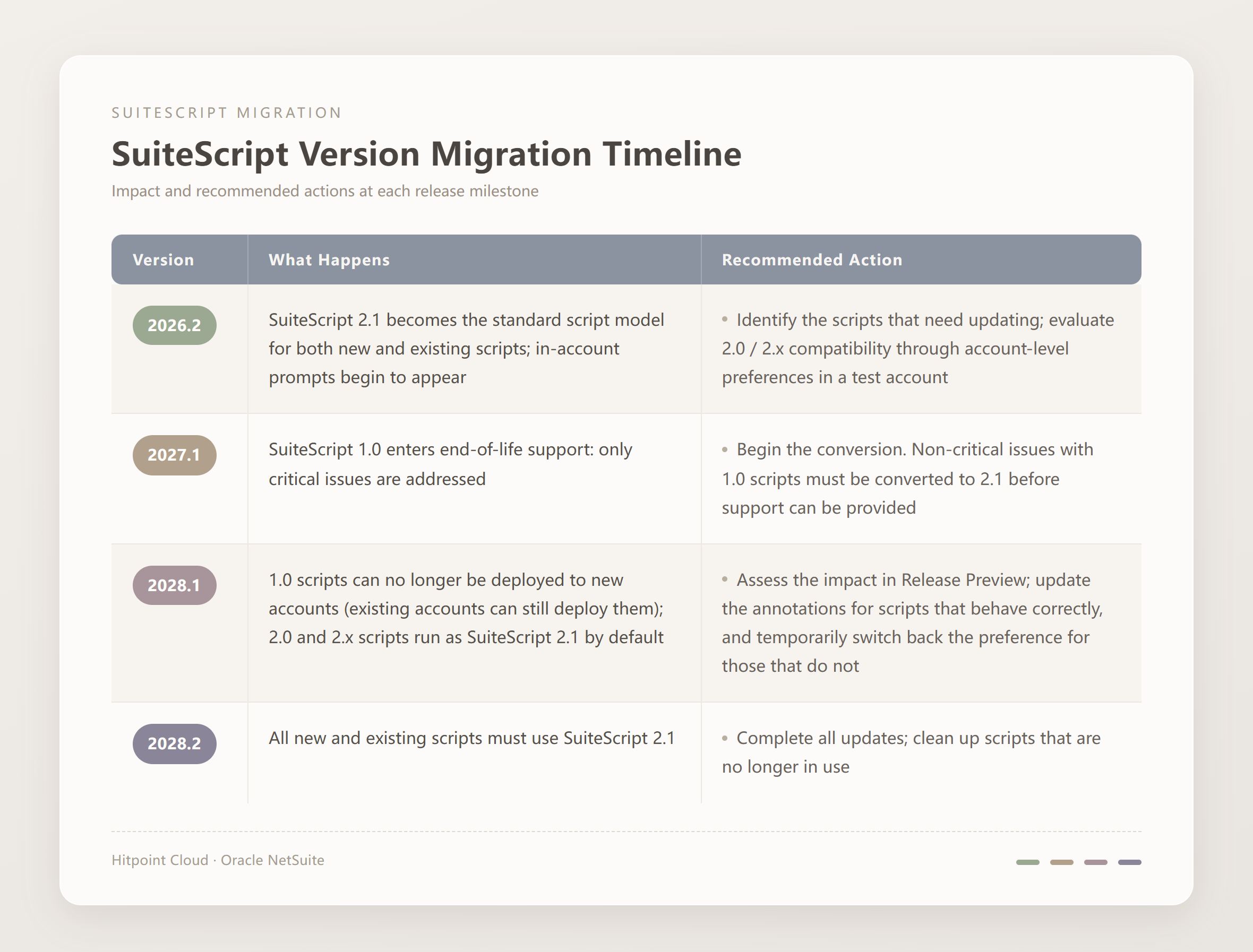
Whilst 2028.2 is the final deadline, there is an earlier milestone that is often overlooked.
According to Oracle’s currently published migration plan, by 2028.1, Oracle NetSuite will automatically migrate all scripts in your account labelled as version 2.0 or 2.x to the new 2.1 environment. This migration is carried out by the system by default—it does not require developers to re-upload code, nor does it require anyone’s approval.
Tip: Oracle NetSuite releases two major versions per year, and customer accounts are upgraded in batches. Therefore, ‘2028.2’ is not a specific date but a time window; the exact date your account is switched over will depend on the schedule arranged by Oracle NetSuite.
Scripts affected are those with JSDoc annotations marked as @NApiVersion 2.0 and @NApiVersion 2.x.
02|Rewriting is only the first step; Subsequent testing and validation must not be overlooked
From a technical perspective, rewriting code from versions 1.0/2.0 to 2.1 is not complicated, and Oracle has already provided official automation capabilities: SuiteCloud Agent Skills – knowledge packages published by Oracle using the agentskills.io open standard, which can be used on more than 25 mainstream AI coding platforms as well as in the SuiteCloud Developer Assistant. However, the real workload lies in the stages following the rewriting:
Test case design and UAT: The behaviour following the changes must be validated against real-world business workflows, rather than merely checking whether the code runs successfully;Regression testing: Scripts are often tightly coupled with approval workflows, integration interfaces and scheduled tasks; a change to a single User Event may affect another piece of logic that has long since fallen into disuse;Deployment and switchover: This must be scheduled to avoid clashing with business cycles such as monthly and quarterly closings, and major sales promotions;Requirements engineering and refactoring of legacy customisations: During migration, it is common to discover that no one knows ‘why it was written that way back then’; at this stage, business requirements must be re-examined, and legacy customisations may even need to be refactored.
In other words—changing @NApiVersion from 1.0 to 2.1 is the simplest part of the entire migration; proving that the same set of business processes, integrations, approvals and financial controls remain correct under version 2.1 is where the real challenge lies.
03|What Hitpoint Cloud Can Do
Since 2009, Hitpoint Cloud has specialised in Oracle NetSuite products. With an implementation and development team of over 100 people, we have served more than 400 corporate clients and are Oracle NetSuite’s first authorised training centre in China.
For this SuiteScript 2.1 migration, we provide end-to-end services from inventory taking to go-live:
① Script Asset Inventory and Health Assessment: We catalogue all scripts and deployments within the account, producing a list that includes script/deployment IDs, current version labels, script types, relevant record types and events, external calls, last execution time, and business owners. We then prioritise the migration queue based on the criteria: ‘legacy runtime × business impact × execution frequency × external side effects’.
② Migration Strategy Design and Code Rewriting: Conversion is carried out using Oracle’s official SuiteCloud Agent Skills and Hitpoint Cloud’s proprietary Agent platform, Hitpoint XAgent, within the NetSuite AI Skill Suite. We have implemented a company-wide policy mandating that all new scripts must use SuiteScript 2.1, and that new scripts generated by AI must also comply with version 2.1. For APIs with no direct equivalents in the Oracle API Map, senior developers manually review and refactor each one individually.
③ Review of Third-Party SuiteApps and Bundles and Recommendations for Action: Conduct compatibility reviews of third-party SuiteApps and Bundles already installed in the account, provide recommendations for action (awaiting an upgrade from the publisher, replacement, or in-house refactoring), and assist with follow-up.
④ UAT, Regression Testing and Deployment Support: Develop test cases, perform regression testing in the Release Preview / Sandbox environment using real-world entry points, and arrange deployment windows that are staggered to avoid clashing with business operations. This is the stage of the entire migration process that most requires business expertise and project collaboration.
⑤ Liaison with Oracle: We will centrally manage all communications and administrative matters relating to Oracle during the upgrade process.
04|Incidentally: another upgrade is also scheduled within the same window
In addition to the SuiteScript version upgrade, Oracle NetSuite’s integration certification mechanism is also undergoing changes.
Oracle has announced that, from version 2027.1 onwards, new SOAP Web Services, REST Web Services and RESTlets integrations using TBA will no longer be permitted; support for existing TBA integrations is scheduled to be phased out in subsequent versions.
These two upgrades—one affecting ‘internal scripts’ and the other ‘external interfaces’—are taking place in quick succession. If your account is affected by both, it is often more efficient to assess them together—the same script inventory can be reused, and a single Release Preview validation can cover both areas.
We offer the ‘Oracle NetSuite Technology Stack Dual Upgrade Assessment’, which provides a single overview of the scope of impact and migration plans for both the OAuth 2.0 and SuiteScript 2.1 upgrades.
05|Three actions you can take now
First, confirm the scope of impact
Determine exactly how many 1.0, 2.0 and 2.x scripts are present in your account, and which of these are still actively running in production.
Determine which scripts do not need to be migrated
Historical scripts that are disabled, redundant or have already been replaced can be prioritised for removal, ensuring that customisations no longer required are not included in the migration scope.
Draw up a migration plan as early as possible
Based on the number of scripts, business criticality, third-party dependencies and the organisation’s own development resources, determine whether this is a minor technical adjustment or a dedicated project requiring advance planning.
If your Oracle NetSuite account has already displayed an ‘Update Needed’ alert, but you are currently unsure of the number of affected scripts, the migration workload, or the scope of impact on third-party SuiteApps, you may wish to conduct a dedicated assessment first.
Hitpoint Cloud can assist in mapping the scope of impact, assessing migration risks and drawing up a corresponding upgrade plan, based on the current status of your account. Visit our website to find out more: https://www.hitpointcloud.com/en
-
2026/09/24
[Product Updates] An Analysis of the Oracle NetSuite SuiteScript 2.1 Migration Path: From Inventory to Migration – Preparing for 2028.2
-
2026/09/10
[New Client Update | Freemen Nutra] Oracle NetSuite × Hitpoint Cloud empowers a life sciences company to upgrade its digital management
-
2026/08/27
[Cloud Solutions Spotlight]As Chinese enterprises expand overseas, this marks the ‘year of establishing a foothold’;why has AI-native ERP become a must-have?
-
2026/08/21
[Cloud Solutions Spotlight] Worried about falling into pitfalls when choosing a cloud ERP? Use these 5 criteria to distinguish between ‘true cloud’ and ‘pseudo-cloud’