


Financial Technology
Internet securities companies and futures companies: global financial management; global operation of voucher codes; Cryptocurrency wallet: asset management, custody and investment management;

Trends
1. In recent years, with the rapid development of new-generation information technology, fintech companies have mushroomed and grown rapidly in various segmented financial sectors, reshaping the traditional financial landscape;
2. Digital products and virtualized assets in the new era, with their high growth potential and inherent risk resistance, provide customers with more investment options and new economic inclusiveness featuring cost reduction and efficiency enhancement;
3. The replacement trend of pure business software in the existing financial industry is obvious, and the process of business-finance integration is gradually accelerating;
4. With the application of cloud computing, high-quality domestic fintech enterprises and products have also started to go global;

Key Challenges
For securities and futures trading businesses, virtual currency banking and investment businesses, financial compliance and customization requirements are extremely high;


-

Financial-grade security requirements
-

Requirements for rapid processing of large-volume transaction documents
-

Demands for detailed bookkeeping of client fund custody and direct bank-enterprise connection

Solutions
Hitpoint boasts extensive experience in global financial management for securities companies, full lifecycle management of coupon codes and vouchers, as well as virtual currency banking and investment businesses.
1. Global Financial Management for Securities Companies: Mainly US and Hong Kong stocks
Detailed global financial bookkeeping, business data analysis, financial forecasting based on operational data, fund position management and allocation management;
Systematic financial master data: Brokers, banks (institutions and accounts), product lines, business lines, projects, wealth management products, etc.;
Main business income: Commissions, foreign exchange, interest, margin trading and short selling, licensing fees, advertising fees, etc.; to be automatically integrated with the front and middle offices in the future;
Main business costs: Labor, IT, commissions, interest, clearing fees, marketing expenses, market data fees, etc.;
Expense management: R&D expenses, inter-company expenses, etc.; collaboration between expense control software and electronic archive systems;
Three major report systems: Statutory reports, management reports, and securities regulatory reports;
2. Integrated Business-Finance Management for Futures Trading:Template docking with futures trading platforms: futures quotes, futures contracts, futures transaction records;
Futures market and transaction management: futures trading master data, futures commodities / futures contracts, daily market record import, futures transaction record import, fair value change tracking reports;
Futures management reports: Basis reports, position reports, inventory floating profit and loss, floating profit and loss of unexecuted contracts, futures floating profit and loss statements, etc.;
3. Integrated management of virtual currency and legal currency, with exchange rate docking to CoinMarketCap;
Closed-loop management of virtual currency wallet asset management and custody services, transaction details of wealth management businesses and bookkeeping details of custodial funds;
Real-time presentation of virtual currency investment business management and project profit and loss reports;
4. Full Lifecycle Management of Voucher Codes:
Voucher code master data management, multi-mode procurement management (code pool procurement and API procurement);
Batch inventory management and validity period management, synchronization to online wallets and sales result feedback, batch inventory deduction;
Multiple procurement reconciliation and write-off modes: settlement based on purchased quantity, settlement based on write-off quantity, etc.
Related Cases
-


A digital asset security management platform organisation
Helping An C Enterprise's Virtual Currency Wallet Business to Integrate and Automate Operations and Finance
Learn More

-

A global investment fund organisation
Enabling An M Enterprise to Manage the Full Lifecycle of Virtual Coin Investments and Real-Time Profit Analysis
Learn More
-

A domestic digital financial services organisation
Helping An A Enterprise's Overseas Digital Wallet Industry and Finance Integration Operation
Learn More
-

ALVEAN
Helping ALVEAN China to realise an integrated business and financial operation for sugar futures spot trading
Learn More
-

A well-known international securities company
Helped a leading T securities company achieve globalization, conglomeration, business-finance integration, and ultra-fine-grained precision operations.
Learn More
Latest News
-

 2026/09/24
[Product Updates] An Analysis of the Oracle NetSuite SuiteScript 2.1 Migration Path: From Inventory to Migration – Preparing for 2028.2
Learn More
-
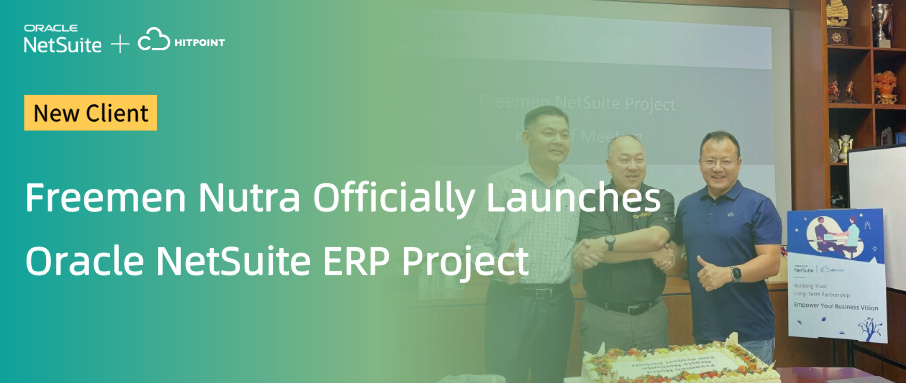 2026/09/10
[New Client Update | Freemen Nutra] Oracle NetSuite × Hitpoint Cloud empowers a life sciences company to upgrade its digital management
Learn More
-
 2026/08/27
[Cloud Solutions Spotlight]As Chinese enterprises expand overseas, this marks the ‘year of establishing a foothold’;why has AI-native ERP become a must-have?
Learn More